In part one I walked you through how to pack your bike so it survives the belly of an airplane. If you missed it, start there first: Your First Bike Flight: How to Pack. A well packed hard case is not just about protection. It is the single biggest factor in whether you pay a fair checked bag rate or get hit with a surprise fee at the counter.
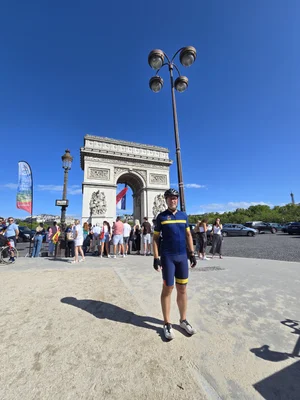
Now let me talk money. Airline bike fees are one of the most confusing and inconsistent parts of endurance travel. One carrier treats your bike like any other suitcase. The next wants a hundred bucks and a reservation made three days out. I have flown my bike across the Atlantic to ride the same climbs the Tour de France tackles, and I have learned exactly where the traps are. Here is how to plan around them.
The one rule that saves you the most money
Get your packed bike under 50 lbs and into a proper hard sided case. That single move flips your bike from an expensive oversized special item into a standard checked bag on most of my preferred airlines. Weigh your case at home on a bathroom scale before you ever leave for the airport. The difference between 49 lbs and 51 lbs can be a hundred dollar overweight charge each way.
My preferred airlines: Delta and SkyTeam
I book Delta and its SkyTeam partners whenever the routing makes sense, and their bike handling is a big reason why.
Delta
Delta is the gold standard here. A properly packed bike in a hard sided case that weighs 50 lbs or less is treated as a standard checked bag. No special bike fee. If you are flying first or business class your weight limit jumps to 70 lbs, which gives you real breathing room for a heavier travel case. Pay your normal checked bag fee and you are done.
Air France (SkyTeam)
Air France matches Delta and treats a properly packed bike as a standard checked bag. The catch: Air France limits each flight to two bikes. You have to call and confirm they have room to accept your bike before you book. Do not assume space is available. I always lock this in the moment my ticket is issued so I am not the third cyclist on a sold out flight.
KLM (SkyTeam)
KLM is the SkyTeam outlier. Your bike is a paid, reservation required item priced by route, and you need to book the bike transport at least 48 hours before departure since hold space is limited. Reserve early and reserve online. KLM special baggage policy.
The other major U.S. carriers
United
United is another easy win. A properly packed bike under 50 lbs rides as a standard checked bag, and the limit rises to 70 lbs in first and business class. Same playbook as Delta. Pack smart, stay under the weight, pay the normal bag fee.
American Airlines
American has quietly become one of the most bike friendly carriers. They removed oversize fees for sports equipment, so a bike under 50 lbs and within 115 linear inches simply counts as your standard checked bag. You pay the regular first bag fee of about $35 online. American sports equipment policy.
Alaska Airlines
Alaska is a hidden gem for cyclists. There is no separate bike fee at all. Your bike is treated like any standard checked bag as long as it stays within 115 linear inches and 70 lbs, which is a very generous weight allowance. You just pay the standard checked bag fee. If you fly the West Coast, Alaska is one of the best options out there.
JetBlue
JetBlue is where I get cautious. They charge a $100 bike fee on top of any checked bag fee, and they cap bike cases at 80 linear inches. Many full sized hard cases exceed that and will be refused even if you already paid. There is a narrow exception: if your bike and case come in under 62 linear inches and 50 lbs, the bike fee is waived. Measure carefully before you count on JetBlue.
International partners worth knowing
British Airways
British Airways does not charge a specific bike fee. Your bike counts as one of your checked bags as long as it fits within 190 x 95 x 65 cm and 23 kg (about 50 lbs). Go over that weight up to 32 kg and you pay a heavy bag charge. They ask you to notify them at least 72 hours before the flight so they can plan hold space, so do not skip that step.
Lufthansa
Lufthansa accepts bikes up to a generous 280 cm (110 in) and 32 kg (70 lbs), but it is a registered sports item. You must register at least 72 hours before departure and wait for it to be confirmed in your booking. The fee varies by route and fare, typically in the $100 to $250 range each way. Bring your confirmation to the counter because gate agents do not always know the policy cold. Lufthansa sports baggage policy.
Air Canada
Air Canada charges a flat $50 handling fee each way, and honestly that is fair money. It buys you a very generous allowance of up to 115 linear inches and 70 lbs with no separate oversize or overweight charge. The fee is waived in Premium Economy and higher. You do need to pre-register your bike with their reservations team since space is not guaranteed.
The airline I do not recommend: Southwest
I want to be direct here because it comes from personal experience. I do not recommend flying your bike on Southwest. Their published policy reads reasonably, but I have run into fees being applied inconsistently at the gate, even when I pulled up the airline's own policy on my phone and showed the agent. When a hundred dollars can swing on which agent you happen to get, that is not a system I trust for something as valuable as your bike. If Southwest is your only option, print the policy, arrive early, and be ready to advocate for yourself.
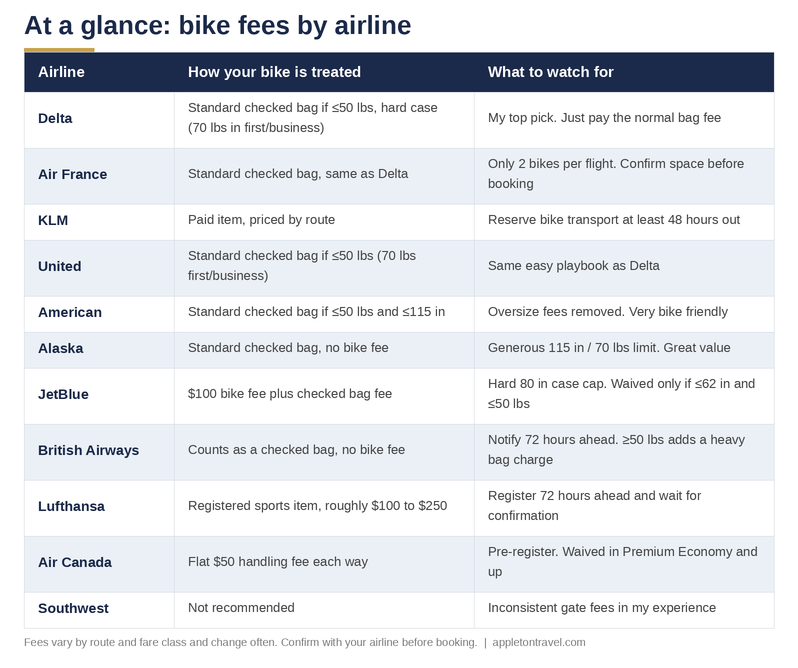
Summary of bike fees by airline as of October 9, 2026. Confirm with your travel advisor before booking.
One more thing: leave the batteries at home
This trips up more cyclists than any fee. No e-bikes and no loose lithium batteries in your checked bike box. Period. Airlines will not fly e-bike batteries in the hold at all, and that same rule reaches into your race setup. If you run electronic shifting, do not leave those batteries in the bike box. Pull your derailleur battery, your derailleur charger, and any spare cells, then carry them in your cabin bag where lithium batteries belong. A forgotten battery can get your whole case pulled at security or refused at check-in.
Let me take the guesswork off your plate
Here is the honest truth. Bike fees, seat maps, hold space, and SkyTeam routing rules are exactly the kind of details that eat up your pre-trip energy right when you should be focused on training. This is what I do. I book the flights that treat your bike right, I confirm bike space on carriers like Air France before your ticket is issued, and I lean on my Fora partnership to layer in VIP hotel perks, room credits, and preferred rates at no extra cost to you compared to booking through a credit card portal yourself.
I do not charge a planning fee. I earn my keep by getting the details right so you show up rested, and your bike shows up in one piece.
Planning a ride abroad or a destination race? Reach out and let's talk through your next trip. Start the conversation here.